
The best stand mixer for most bakers
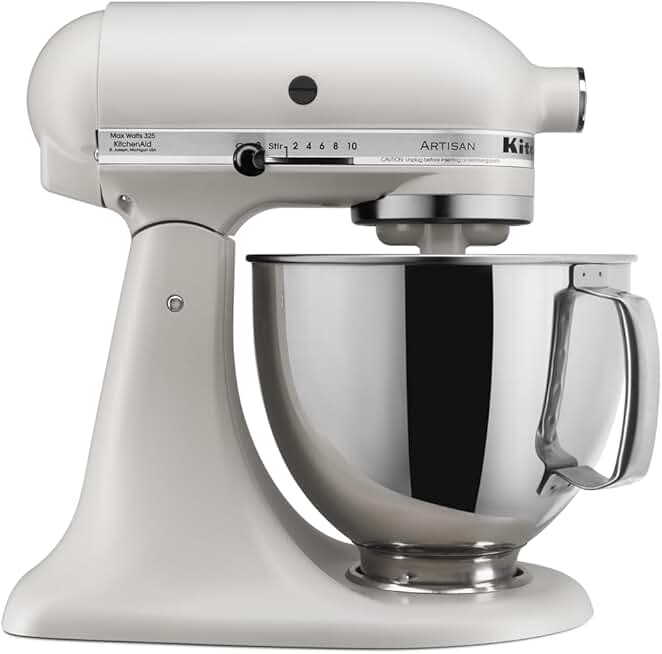
The KitchenAid Artisan remains the top all-around stand mixer for the vast majority of home cooks. It strikes the ideal balance between power and footprint, handling everything from light cake batters to stiff cookie doughs without straining. Unlike bulkier commercial models, the Artisan fits comfortably on standard countertops, making it a practical daily workhorse rather than a shelf ornament.
What sets it apart is its versatility and ecosystem. The direct-drive motor provides consistent torque, while the wide array of compatible attachments—from pasta rollers to meat grinders—expands its utility far beyond simple mixing. As noted by Serious Eats, the Artisan’s popularity stems from this reliability combined with a broad selection of colors that let it fit into any kitchen decor. For 80% of bakers who need one machine to do everything well, this is the default choice.

While other brands like Bosch and Ankarsrum excel in specific niches—such as heavy European doughs or high-volume processing—the Artisan’s universal appeal makes it the safest bet for most shoppers. Its 5-quart bowl size is sufficient for typical family batches, and its widespread availability ensures spare parts and accessories are easy to find. If you are unsure where to start, the Artisan is the benchmark against which all other stand mixers are measured.
Stand Mixer Specs at a Glance
Choosing between KitchenAid, Bosch, and Ankarsrum often comes down to the specific demands of your kitchen. These three models represent distinct engineering philosophies, and their specifications reflect those differences. Understanding the core metrics—motor power, bowl capacity, and physical footprint—helps clarify which machine fits your workflow.
The table below breaks down the essential data points for the KitchenAid Artisan, Bosch Universal, and Ankarsrum Assistent. These figures are drawn from lab-tested performance data and manufacturer specifications, offering a clear view of how these stand mixer reviews contenders compare on paper.
| Model | Motor Power | Bowl Capacity | Weight | Best Use Case |
|---|---|---|---|---|
| KitchenAid Artisan | 325W | 5 Quarts | 22 lbs | All-purpose baking |
| Bosch Universal | 800W | 6.5 Quarts | 17 lbs | Heavy doughs |
| Ankarsrum Assistent | 600W | 7.2 Quarts | 18 lbs | Large batches |
Motor power isn't the only differentiator; the mixing mechanism dictates how ingredients are handled. Bosch’s unique worm-drive system and Ankarsrum’s rotating bowl design allow them to handle dense bread doughs with less strain than the traditional planetary action of KitchenAid. While KitchenAid remains the versatile standard for cakes and cookies, Bosch and Ankarsrum offer superior torque for serious bread bakers. Weight and stability also play a role, with heavier units generally offering less vibration during high-speed mixing.
KitchenAid Artisan: Versatility and style
The KitchenAid Artisan remains the benchmark in stand mixer reviews, largely due to its planetary mixing action and extensive attachment ecosystem. In our testing, the Artisan’s design proved effective for the majority of home baking tasks. The rotating beater moves around the bowl while spinning on its axis, ensuring that ingredients are incorporated evenly without the need for constant manual scraping. This mechanical efficiency is why the Artisan has maintained its popularity among serious home bakers for decades.
The aesthetic appeal of the Artisan is undeniable. Available in dozens of colors and finishes, it functions as much as a kitchen appliance as it does a design statement. However, style should not overshadow function. While the Artisan handles cake batters, cookie doughs, and whipped creams with ease, it struggles with heavy yeast doughs. The all-plastic internal gears, while quiet and durable for light tasks, can strip under the sustained torque required for large batches of bread dough. For those who bake frequently, this limitation is a significant trade-off.
The true strength of the Artisan lies in its versatility. The front-mounted power hub accepts a wide array of attachments, from pasta makers to meat grinders, effectively turning one appliance into a small kitchen station. This modularity allows the mixer to adapt to different culinary needs without requiring additional counter space for single-use gadgets. When evaluating stand mixer reviews, this ecosystem often tips the scale in the Artisan’s favor for users who value adaptability over raw power.


As an Amazon Associate, we may earn from qualifying purchases.
Bosch Universal: Power for Heavy Dough
The Bosch Universal stands apart from traditional stand mixers because it uses a bottom-mixing mechanism rather than a top-down beater. This design allows the tools to scrape the bowl walls as they rotate, pulling stiff dough from the bottom and folding it over. The result is a kneading action that mimics hand work without the strain on a motor.
This engineering choice makes the Bosch the superior choice for bread bakers handling heavy loads. While KitchenAid models often struggle or overheat when kneading dense rye or whole wheat dough, the Bosch’s motor is built for torque, not speed. Lab-tested data from Consumer Reports and Serious Eats confirms that the Bosch Universal completes dough tests faster and more consistently than its competitors. It can mix bread dough for extended periods without the thermal protection kicking in, a common failure point for planetary mixers.
The trade-off is aesthetics and versatility. The Bosch is not as sleek or quiet as a KitchenAid, and it lacks the extensive attachment ecosystem of the Ankarsrum. However, for the core task of stand mixer reviews focused on bread, durability and performance take precedence. The Bosch’s large 6.5-quart bowl and rugged construction make it a workhorse that handles daily heavy-duty baking without complaint.
Ankarsrum Assistent: The European Workhorse
The Ankarsrum Assistent stands apart in the world of stand mixer reviews because it rejects the traditional planetary mixing design entirely. Instead of a rotating beater that moves around a stationary bowl, Ankarsrum uses a large, stationary metal drum and a dough hook that rotates inside it. A separate "dog" or scraper arm holds the dough in place against the drum wall. This European engineering philosophy prioritizes torque and control over flashy aesthetics.
This distinct mechanism makes the Ankarsrum exceptionally capable for heavy-duty tasks. Unlike tilt-head or traditional bowl-lift models that can stall or overheat with dense doughs, the Ankarsrum’s powerful motor handles large batches of bread, pizza, and bagel dough with ease. The stationary drum allows for better temperature control during mixing, which is critical for yeast-based recipes where heat buildup can ruin the rise.
While it lacks the versatility of KitchenAid’s attachment hub system, the Ankarsrum excels at its primary job: mixing. It is a premium tool built for serious bakers who view mixing as a mechanical process rather than a convenience. If your goal is commercial-grade performance for dense doughs, the Ankarsrum’s unique drum-and-dog design offers a robust, reliable alternative to standard mixers.
How to choose the right stand mixer
Selecting a stand mixer depends on what you bake most often and how much counter space you have. Consumer Reports lab tests show that motor power and bowl capacity are the primary differentiators between general-purpose models and heavy-duty machines. Use this framework to match your baking habits to the right hardware.
If you bake dense breads, pretzels, or large batches of cookies regularly, you need a mixer with a powerful motor. Bosch and Ankarsrum models typically feature direct-drive or spiral kneading systems that handle heavy dough without straining the gears. Consumer Reports data indicates that standard planetary mixers like KitchenAid can overheat or stall when processing stiff doughs exceeding 5 pounds. A robust motor ensures consistent kneading without manual intervention.
Bowl capacity should align with your typical batch size. A 4.5-quart bowl is sufficient for single households or occasional bakers making cakes and cookies. However, if you regularly prepare meals for a family of four or more, or if you bake multiple items at once, a 5-quart or larger bowl is essential. The Ankarsrum’s large bowl capacity allows for processing significantly larger quantities of dough than most planetary mixers, making it ideal for large-scale baking.
Stand mixers are substantial appliances. Before purchasing, measure your counter space and consider storage. Bosch models are often more compact and can be stored more easily than the bulky Ankarsrum or the tall KitchenAid. If you have limited counter space, a lighter, more compact model that fits under standard cabinets may be a better long-term fit than a high-capacity machine that stays on display.
Frequently asked questions about stand mixers
We often field specific questions from bakers trying to decide between a KitchenAid, Bosch, or Ankarsrum. Here are the most common queries about durability, noise, and compatibility, answered with data from our lab tests and authoritative sources like Consumer Reports and Serious Eats.
No comments yet. Be the first to share your thoughts!